
How to Engage
Together, we can make our voices hard to ignore.
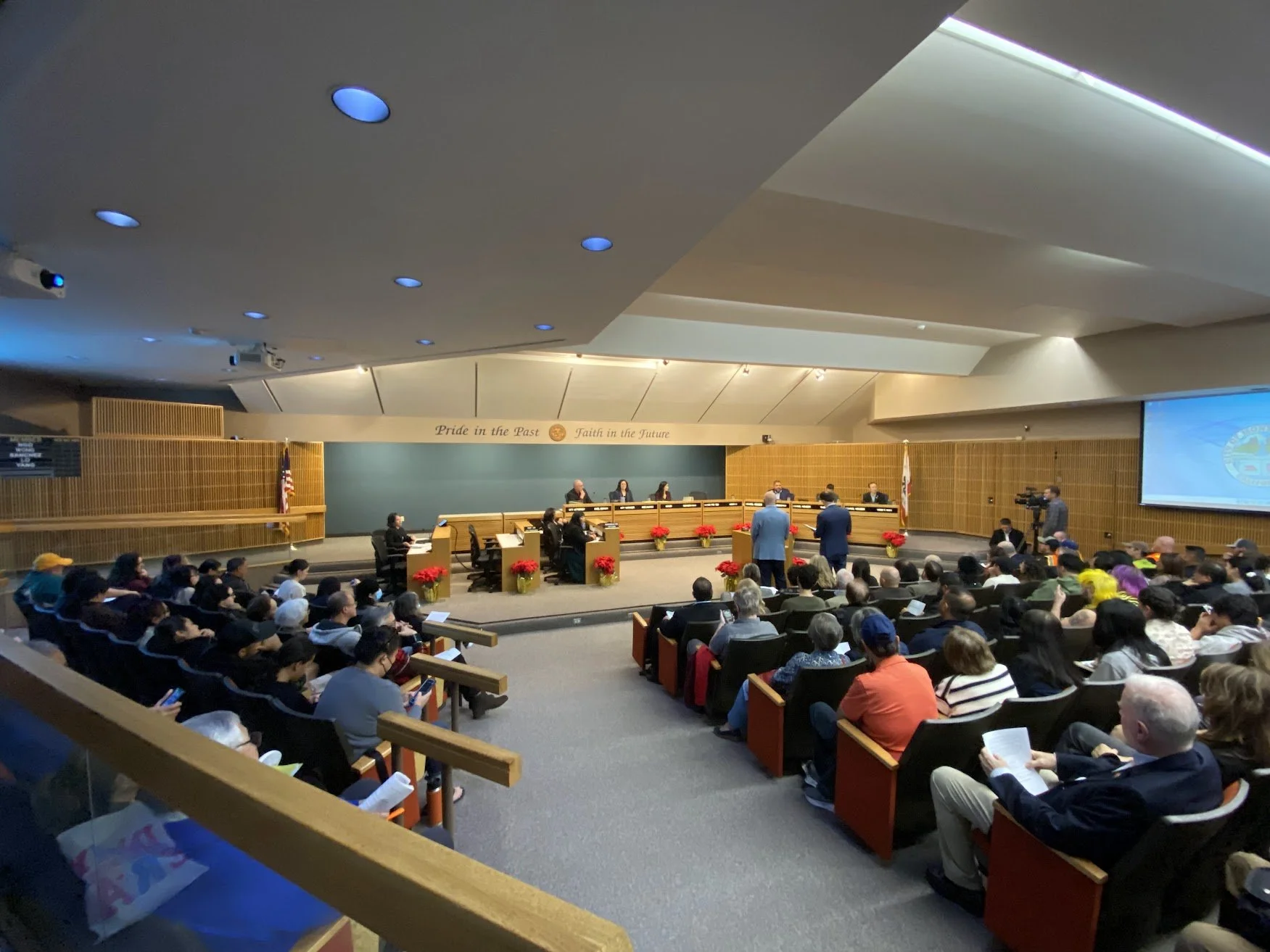
Attend public hearings (date TBD; postponed indefinitely as of December 2025).
Submit written comments to the City of Monterey Park Planning Division citing specific concerns and requesting responses (see contact information below)
Schedule 1:1s with City Council Members and ask them your questions and share your concerns directly (see contact information below)
Request an EIR if you believe there's a "fair argument" that significant impacts haven't been adequately analyzed.
Talk with your neighbors and organize to amplify concerns about cumulative and localized impacts.
Team-up with community-based organizations by following their Instagram or joining email listservs to stay up-to-day and participate.
Follow us on Instagram: @SGVProgressiveAction
"Less Than Significant" ≠ No Impact
You have the right to argue that impacts matter to your community – even if they're deemed legally "insignificant." The phrase "less than significant" is a regulatory conclusion, not a statement that nothing bad will happen. It means that by some measures impacts will fall below a regulatory threshold set by an agency (e.g., The City of Monterey Park). That’s all it means. It does not mean the impact is harmless, negligible, or unnoticeable; that no one will be affected; or that the threshold itself is scientifically or morally defensible.
Under California environmental law (CEQA), once an impact is deemed "significant", it requires a full Environmental Impact Report (EIR) – a lengthy, expensive, and rigorous review process. If all impacts are deemed "less than significant," the project can proceed with just an MND – a faster, cheaper, streamlined review.
Applicants have strong incentives to produce MNDs and avoid EIRs: they save time and money, face less public scrutiny, and avoid identifying alternatives or additional mitigation measures. But MNDs are also easier to challenge legally. If opponents can show a "fair argument" that significant impacts exist – even if the applicant's consultants disagree – a court can require a full EIR.
This is where public comments matter. Your testimony can help establish the record needed to argue that significant impacts weren't adequately analyzed. The applicant wants a quick approval; you can make the case that this project deserves a harder look.
Framing Questions & Attack Angles
Some questions to raise to City Council in public comment and letters:
Air Quality: "Construction NOx emissions exceed SCAQMD thresholds by 77% in 2025. What specific mitigation measures will be implemented, and why wasn't an EIR required?"
Water: "What is the contingency plan if mandatory water restrictions are imposed during drought? Can the facility operate with reduced water availability? Will the facility be exempt from the restrictions and who gets priority access? How will the initial fill of the cooling system impact the surrounding habitats?"
Noise: "Emergency generators are exempt from noise limits. What are the expected noise levels if all 24 generators operate during an extended outage?"
GHG: "What project-level commitments will reduce greenhouse gas emissions before 2045? Why is no renewable energy required? What level of GHG would be deemed significant if 77,034 MTCO₂e does not count as such?"
Cumulative Impacts: "What other large projects are proposed in the area, and how do their combined impacts affect air quality, noise, and utility demand? Should we protect against other similar projects from coming to Monterey Park, for example at 1980 Saturn? What safeguards are there that Monterey Park won’t become an industrial wasteland?”
Precedent-Setting Concerns: “Approving this project without requiring renewable energy, water conservation commitments, or construction emissions mitigation sets a precedent for future data center applications. If ‘less than significant’ findings are accepted despite threshold exceedances, what standard remains?”
City Council Contacts - Monterey Park
Yang, Elizabeth
Mayor and Council Member, District 2
626-307-1465
Lo, Henry
Mayor Pro Tem and Council Member, District 4
626-307-1465
Sanchez, Jose
Council Member, District 3
626-307-1465
Planning Division Contacts
Hou, Timothy
Director of Community Development
626-307-1463
Chow, Beth
Planning Manager
626-307-1318
Muñoz, Eliana
Senior Planner
626-307-1304
Wong, Thomas
Council Member, District 1
626-307-1465
Ngo, Vinh T.
Council Member, District 5
626-307-1465
Tan, Kevin
Assistant Planner
626-307-1302
Sanchez, Nikole
Permit Technician I
626-307-1307